The NFL Scouting Combine remains the ultimate proving ground where collegiate potential meets professional measurement.
In recent years, the evaluation of “explosiveness” has shifted from subjective scouting reports to precise data points that define a prospect’s ceiling.
Two specific cycles—the 2025 and 2026 combines—have provided a masterclass in how size and speed are redefining traditional positional archetypes.
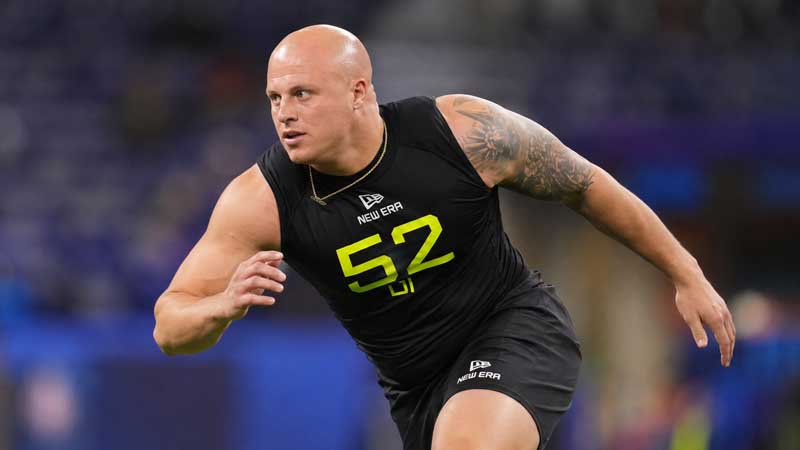
At the center of this conversation is former Arkansas defensive end Landon Jackson, whose performance serves as the gold standard for the modern edge rusher.
The Physics of a Powerhouse: Landon Jackson’s 2025 Performance
When evaluating the trajectory of defensive prospects, the 40-yard dash often captures the headlines, but the underlying metrics tell a more complete story of NFL readiness.
During the 2025 event, Landon Jackson delivered a performance that immediately separated him from his peers.
Standing at a towering 6-foot-6 and weighing 264 pounds, Jackson’s physical presence alone was noteworthy. However, it was his movement efficiency that solidified his status as an elite prospect.
Jackson clocked an official 4.68-second 40-yard dash, a time that is rare for a player of his length and mass. For context, a sub-4.7 time at 260+ pounds places a player in a tier of athleticism shared by some of the league’s most disruptive defensive ends.
Even more impressive than the total time was his 1.65-second 10-yard split. In the NFL, the first ten yards determine whether a defender can clear the offensive tackle’s reach; a 1.65-second burst is indicative of high-tier fast-twitch muscle response.
The vertical and broad jumps further corroborated this explosiveness. Jackson recorded a 40.5-inch vertical jump and a 10-foot-9-inch broad jump. These figures aren’t just good for a defensive end—they are elite for any position on the field.
High vertical numbers for a player of his height suggest an ability to disrupt passing lanes and dominate at the point of attack using lower-body leverage.
The 2026 Scouting Combine: A New Class of Moving Mountains
Following the benchmark set by Jackson, the 2026 Scouting Combine showcased a new generation of athletes, particularly in the offensive and defensive trenches.
The 2026 event demonstrated that the trend toward leaner, faster, and more explosive linemen is not an anomaly but the new requirement for professional success.
Standout Offensive Line Performance
The offensive tackle and guard positions in 2026 saw a remarkable display of straight-line speed. Several prospects recorded 40-yard dash times that would have been competitive for tight ends a decade ago:
- Aamil Wagner (Notre Dame): Recorded an official 5.01-second 40-yard dash.
- Dillon Wade (Auburn): Posted a 5.02-second 40-yard dash.
- Blake Miller (Clemson): Ran a 5.04-second 40-yard dash while also demonstrating significant lower-body power with a 9-foot-5-inch broad jump and a 32-inch vertical.
- Jake Slaughter (Florida): Notched a 5.10-second dash time.
These times are critical because they reflect the increasing demand for “mobile” blockers who can lead-block on screens or pull across the formation with the speed to mirror elite edge rushers.
The Verticality of the 2026 Trench Prospects
Explosiveness was the theme of the jumping drills in 2026. Caleb Lomu of Utah emerged as one of the most physically gifted prospects of the class. Lomu recorded a staggering 39-inch vertical jump and matched Blake Miller’s 9-foot-5-inch broad jump.
His performance was so impactful that NFL Network analyst Daniel Jeremiah compared his movement profile to that of Abraham Lucas of the Seattle Seahawks.
Similarly, Emmanuel Pregnon of Oregon showed high-level athleticism for a guard, recording a 35-inch vertical and a 9-foot-3-inch broad jump. Caleb Tiernan from Northwestern also cleared the 35-inch mark in the vertical jump, posting a 35.5-inch leap.
Expert Evaluations and Professional Comparisons
Data points provide the “what,” but expert analysis provides the “why.” During the 2026 Combine, several analysts noted how these numbers translated into draft stock.
Marc Ross detailed that several prospects saw their valuations rise significantly due to their on-field drills, as teams looked for players whose athletic testing matched their collegiate tape.
One of the most notable comparisons came from Charles Davis, who evaluated Miami Hurricanes tackle Francis Mauigoa. Davis likened Mauigoa to Detroit Lions star Penei Sewell, a comparison that speaks to a rare blend of massive size and nimble footwork.
Furthermore, Daniel Jeremiah highlighted Olaivavega Ioane of Penn State, comparing his physical traits to those of veteran guard Kevin Zeitler.
Ioane himself described his journey to the NFL and the hard work behind his workout performance during live interviews at the event.
The use of Simulcam technology at the event allowed for these comparisons to be visualized in real-time.
By overlaying the 40-yard dashes of the 2026 prospects against past greats—and even the annual Rich Eisen 40-yard dash—the sheer speed of the 2026 class became evident.
Why Landon Jackson’s Metrics Remain Relevant
While the 2026 class brought its own set of “freaks,” the numbers posted by Landon Jackson in 2025 remain a vital reference point.
A 4.68-second dash at 264 pounds is a specific threshold. It represents the “hybrid” defender who can play as a traditional 4-3 defensive end or a 3-4 outside linebacker.
The correlation between these testing numbers and NFL success is often found in the “closeness” of the metrics.
A player like Jackson, who excels in the 10-yard split (1.65s) and the vertical jump (40.5″), possesses the “get-off” speed necessary to win the corner against tackles like Aamil Wagner or Dillon Wade, who are themselves moving at elite speeds.
The Strategic Takeaway for NFL Teams
As the 2026 draft cycle approaches, the data from Indianapolis confirms a permanent shift in player evaluation. Teams are no longer just looking for big players; they are looking for explosive giants.
The benchmark set by Landon Jackson’s 40-yard dash and vertical leap remains a primary target for defensive evaluators. Meanwhile, the 2026 class has proven that offensive linemen are becoming faster and more athletic to counter these high-speed defensive threats.
The integration of advanced metrics and professional comparisons ensures that the NFL Draft is less of a guessing game and more of a precision-based selection process. For fans and analysts, these numbers are the first glimpse into the next decade of NFL stardom.