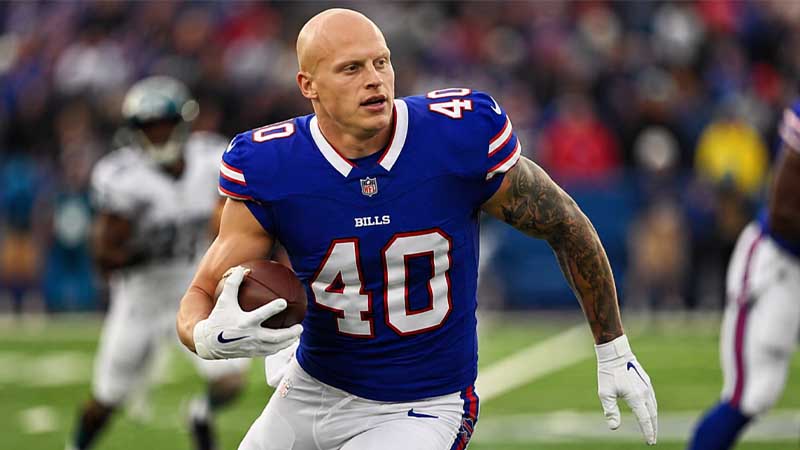
In the high-stakes arena of elite collegiate football, where every physical attribute is scrutinized and every player is measured by their performance under pressure, few individuals command attention quite like Landon Jackson.
While his formidable presence on the defensive line is the primary reason for his acclaim, many observers and fans frequently ask about his distinctive appearance—specifically, why he has no hair or eyebrows.
This is not a choice of style or a trend in athletic grooming. It is the visible manifestation of a lifelong journey with a medical condition that Jackson has transformed from a personal challenge into a powerful platform for leadership.
By understanding the “why” behind his look, we gain insight into the character of a man who defines himself not by what he has lost, but by what he has built.
The Medical Reality: Demystifying the Condition
The reason for Landon Jackson’s lack of hair and eyebrows is a diagnosis of alopecia, an autoimmune condition he has lived with since early childhood.
While the term is often used broadly, it represents a specific biological process where the body’s internal defense systems become misaligned.
In a standard biological environment, the immune system identifies and attacks foreign invaders like viruses or bacteria. However, for those living with alopecia, the immune system mistakenly identifies hair follicles as a threat.
This results in the system attacking the follicles, which leads to varying degrees of hair loss. In Jackson’s case, this includes the total loss of hair on his head as well as body hair, such as eyebrows.
It is important to note that while the physical effects are striking, alopecia does not typically impact other areas of physical health or athletic performance.
For Jackson, the condition is a part of his physical identity, but it has never been a barrier to his capabilities on the field. Instead, it has served as a foundational element of his personal narrative.
A Timeline of Resilience: The Early Years
The journey for Jackson began far before he ever stepped onto a collegiate football field. He was diagnosed with the condition at an exceptionally young age, typically cited as being between four and five years old.
For most children, these are the years of early socialization and the beginning of school, a time when physical differences can become a focal point for peer interaction.
Facing a diagnosis that alters one’s appearance at such a formative age requires a level of psychological fortitude that few adults possess.
While the loss of hair began in early childhood, Jackson made a definitive choice to take control of his appearance just a few years later. By the age of seven, he began shaving his head regularly.
This decision is significant. For a seven-year-old to adopt a regular grooming routine to manage an autoimmune condition demonstrates an early inclination toward discipline and self-acceptance.
Rather than allowing the condition to dictate his appearance through patchy or unpredictable hair loss, Jackson chose to define his own look. This early move toward autonomy likely contributed to the “unfiltered” confidence he displays today as a public figure.
The Psychological Edge: Turning Adversity into Advantage
In professional and high-level collegiate sports, mental toughness is often the deciding factor between a good player and a great one. Jackson’s experience with alopecia has provided him with a unique form of mental conditioning.
Navigating the world with a visible difference from the age of five requires a person to develop a thick skin and a secure sense of self.
For Jackson, his appearance has never been something to hide. By being open about his diagnosis, he removes the power of the “unknown” and replaces it with facts.
This transparency is a hallmark of elite leadership. In an environment like the SEC, where the pressure is immense and the spotlight is constant, Jackson’s ability to stand comfortably in his own skin serves as a quiet but powerful testament to his internal strength.
The Role of an Advocate: Leadership Beyond the Box Score
While many athletes focus solely on their performance, Landon Jackson has embraced a broader responsibility.
He has utilized his visibility to become a champion for the alopecia community. This advocacy is not just about awareness; it is about providing a tangible roadmap for confidence for those who are currently where he once was.
Jackson speaks openly about his journey, focusing on building the self-esteem of children who are navigating similar diagnoses. His efforts include:
- Direct Engagement: He actively connects with children who have alopecia, providing a visible example of success and strength.
- Words of Encouragement: He offers personal support to young fans, helping them understand that their condition does not define their potential.
- Community Support: In a gesture that bridges his professional world with his advocacy, he has been known to provide game gear and equipment to children in the alopecia community, creating a sense of belonging and pride.
By doing this, Jackson shifts the narrative. He isn’t just a football player who happens to have alopecia; he is a leader who uses his platform to ensure that the next generation of children with autoimmune conditions feels empowered rather than marginalized.
The Impact on the Sports World and Beyond
Jackson’s presence in the sports world is a vital signal for representation. High-profile athletes are often viewed as the “ideal” of physical perfection.
When a player like Jackson—who is an elite physical specimen and a top-tier competitor—openly discusses a condition like alopecia, it broadens the definition of what a “perfect” athlete looks like.
This level of representation is essential for inclusivity. It demonstrates that physical differences are not “defects” but are simply variations of the human experience.
For a young athlete who might be struggling with a diagnosis, seeing Jackson dominate on Saturday afternoons provides a powerful counter-narrative to any feelings of inadequacy.
Conclusion: A Legacy Defined by More Than Football
Landon Jackson’s story is a reminder that our most visible differences can often be the source of our greatest impact.
While he will undoubtedly be remembered for his contributions to his team and his prowess on the defensive line, his legacy extends far beyond the stadium walls.
By choosing to be the face of alopecia in the world of elite sports, Jackson has provided a voice for the voiceless and a face for a community that is often misunderstood.
He has proven that true strength is not just found in the weight room or on the practice field—it is found in the courage to be exactly who you are, without apology.
Landon Jackson does not have hair or eyebrows because of a biological quirk, but he has a platform and a purpose because of his character.
As he continues his career, he remains a definitive example of how to lead with integrity, transparency, and a commitment to lifting others.