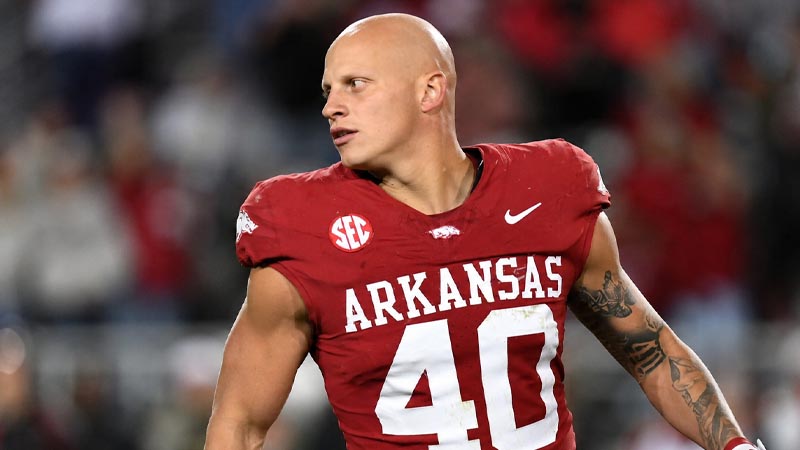
In the high-stakes environment of professional football, physical presence often serves as the first chapter of an athlete’s story.
For Landon Jackson, the towering defensive end whose athleticism has captured the attention of scouts and fans alike, that presence is defined by more than just his reach or his speed off the edge.
One of the most frequently asked questions surrounding the defensive standout pertains to his distinctive look: Why is Landon Jackson bald?
The answer is not a matter of personal style or a grooming preference for the field. It is a story of medical reality, childhood resilience, and a deliberate choice to turn a personal challenge into a platform for global advocacy.
Jackson’s journey began long before he stepped onto a college or professional turf, rooted in a diagnosis that would eventually shape his character as much as his career.
The Early Diagnosis: A Life-Altering Discovery
Landon Jackson’s path took an unexpected turn at the age of five. While most children his age were focused on kindergarten and playground games, Jackson was diagnosed with alopecia, an autoimmune condition.
Alopecia occurs when the body’s immune system mistakenly attacks the hair follicles, leading to patchy or, in more severe cases, total hair loss.
For a young child, the sudden and uncontrollable loss of hair can be a confusing and frightening experience. By the time Jackson reached the age of seven, the progression of the condition led to the decision to begin completely shaving his head.
This transition at such a formative age meant that Jackson’s entire elementary and middle school experience was marked by a physical appearance that set him apart from his peers.
In the world of elite athletics, where “looking the part” often translates to traditional standards of toughness, Jackson had to find a different kind of strength—one that resided beneath the surface.
Navigating Childhood Adversity and Mental Health
The psychological impact of alopecia, particularly on children and adolescents, is profound. For Jackson, the visible nature of his condition made him a target.
He faced significant hurdles during his youth, including bullying, anxiety, and deep-seated self-doubt.
The formative years are typically defined by a desire for conformity and belonging. When a child looks different, especially due to a condition they cannot control, the social friction can be intense.
Jackson has been open about the internal battle he fought during this time. The anxiety stemming from his appearance wasn’t just about vanity; it was about the fundamental human desire to be seen for who you are rather than what you lack.
These early struggles are a critical component of the Landon Jackson story. They provide the “why” behind his current leadership style.
He didn’t just wake up as a confident, 6-foot-7 powerhouse; he had to build that confidence from the ground up, navigating a world that often judged him before he even spoke.
Football: The Sanctuary of Performance
Many athletes find a sense of peace on the field, but for Jackson, football was a literal sanctuary. It was the environment where his physical differences ceased to be a liability and became a footnote to his performance.
Jackson found that the gridiron provided a unique sense of belonging. Within the confines of a locker room and under the lights of a stadium, the meritocracy of sport took over.
His value was no longer tied to his appearance but to his productivity, his work ethic, and his ability to protect his teammates.
Football helped Jackson find his value. It allowed him to transform the self-doubt of his youth into a fierce competitive drive.
The sport gave him a community where he was judged by the strength of his character and the impact of his play. This shift in perspective was transformative, allowing him to embrace his identity fully—both as an athlete and as a man with alopecia.
A Platform for Advocacy: The NFL and Beyond
Now that he has reached the pinnacle of the sport as an NFL defensive end, Jackson has not forgotten the child who struggled with anxiety and bullying.
Instead of shying away from his condition, he has integrated it into his professional identity, using his visibility to act as a role model for others.
Jackson frequently dedicates his time to meeting with children who have also been diagnosed with alopecia.
He understands that for these children, seeing a professional athlete—someone who is the epitome of physical “toughness”—who looks like them can be life-changing.
His advocacy focuses on:
- Raising Awareness: Educating the public on what alopecia is (and isn’t) to reduce the stigma associated with hair loss.
- Combating Bullying: Sharing his personal stories of overcoming childhood taunts to provide a roadmap for resilience.
- Encouragement: Offering a living example that a medical diagnosis does not have to limit one’s aspirations or self-worth.
By standing at the forefront of the NFL with a shaved head and a message of empowerment, Jackson is redefining what it means to be a “tough guy.” He is showing the world that true strength is found in vulnerability and the courage to be oneself in the face of adversity.
The Science of Resilience: Understanding the Autoimmune Connection
To fully appreciate Jackson’s journey, it is helpful to understand the broader context of the condition he manages. Alopecia is not a lifestyle choice or the result of stress; it is a complex biological event.
When the immune system targets hair follicles, it disrupts the natural growth cycle. For many, this is a lifelong journey of managing flare-ups or permanent loss.
In a professional sports setting, where physical health is meticulously monitored, Jackson’s ability to maintain peak performance while navigating an autoimmune condition speaks to his discipline.
His story highlights a broader truth: many high-performing individuals deal with “invisible” or “visible” health challenges that require immense mental fortitude to overcome.
Conclusion: A Legacy Built on More Than Sacks
Landon Jackson’s legacy will certainly be measured by his statistics on the field—his sacks, his tackles for loss, and his contribution to his team’s success.
However, for a significant portion of his fans, his greatest impact will be the way he carries himself off the field.
By being open about his diagnosis at age five and the subsequent struggles with self-doubt, he has provided a voice for the voiceless.
He has proven that a shaved head isn’t just a look; it’s a badge of a battle won against insecurity.
In a world that often demands perfection, Landon Jackson stands as a reminder that our “flaws” or differences are often the very things that forge our greatest strengths.
Whether he is chasing down a quarterback or sitting in a room of children sharing his story, Jackson remains a testament to the power of resilience.