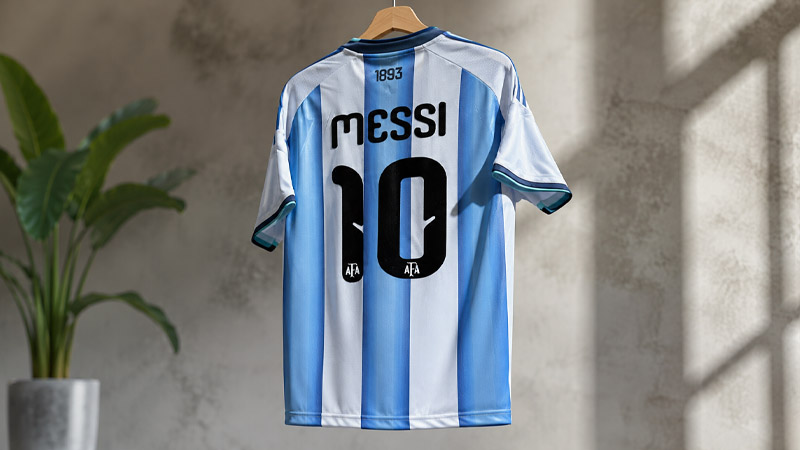
As Lionel Messi and the Argentine national team stepped onto the pitch for the 2026 World Cup, fans worldwide noticed a curious detail on the back of their sky-blue and white jerseys.
Stitched directly below the neck is the four-digit number 1893, a detail that quickly went viral across social media platforms like TikTok and global news outlets.
This subtle numeric addition is far more than a stylistic choice; it is a profound tribute to the deeply rooted history of Argentine football. This design serves as a bridge between the nation’s 19th-century origins and its modern status as a global powerhouse.
Decoding the 1893 Mystery on Argentina’s 2026 Kit
The inclusion of the year 1893 on the official 2026 World Cup jersey is a calculated decision by Adidas and the Argentine Football Association to celebrate the longevity of the sport in the country.
By placing this number in such a prominent position—just beneath the collar—the kit highlights a journey that has spanned over 130 years of excellence.
This section explores the specific historical event that 1893 commemorates and why it remains a point of immense pride for the Argentine people.
The Birth of the Argentine Football Association
The number 1893 represents the founding year of the Argentine Football Association (AFA). Specifically, the association was officially established on February 21, 1893, in the city of Buenos Aires.
While football was already being played in the region, this date marks the formalization of the sport, creating a governing body that would eventually oversee three World Cup victories.
The AFA remains one of the world’s oldest football governing bodies, and its early establishment gave Argentina a significant head start in developing a national footballing identity.
A Global Milestone in Football History
Beyond its national importance, the date 1893 holds international significance in the world of sports administration. The AFA holds the distinction of being the first football association of its kind established outside of Europe.
This historical fact underscores Argentina’s early adoption of the sport and its role in pioneering organized football in the Americas.
By featuring this year on the back of the jersey, the team reminds the world that their footballing heritage is among the most venerable and prestigious in existence.
The Visionary Behind the Legacy: Alexander Watson Hutton
To understand why the year 1893 is so revered, one must look at the individual who made the organization possible. The history of Argentine football is inextricably linked to a Scottish educator whose vision transformed a local pastime into a national obsession.
This section delves into the life and impact of the man whose legacy is essentially stitched into every official 2026 jersey worn by the national team.
The Scottish Roots of Argentine Football
The Argentine Football Association was founded by Alexander Watson Hutton, an immigrant educator who moved to Argentina from Scotland. Hutton arrived in Buenos Aires with a passion for both education and the relatively new sport of football.
He recognized the potential for the game to serve as a unifying force and worked tirelessly to create a structured environment where competitive matches could take place.
His efforts in the late 19th century laid the groundwork for the club structures and developmental leagues that still exist in Argentina today.
Why Hutton is Called the “Father” of the Game
Alexander Watson Hutton is widely and officially considered the “father” of Argentine football. His leadership during the formative years of the AFA ensured that the sport grew beyond immigrant communities and became a central pillar of Argentine culture.
The 1893 branding on the 2026 kit acts as a direct tribute to Hutton’s visionary work. It serves as a reminder that the stars like Messi and Maradona are part of a continuous lineage that began with Hutton’s efforts to institutionalize the game in South America over a century ago.
Hidden Symbols and the Anatomy of the 2026 Jersey
While the 1893 detail has captured the most headlines, the 2026 World Cup jersey is a masterpiece of symbolic design that incorporates multiple layers of history.
Adidas has utilized this kit to tell the story of Argentina’s greatest triumphs, blending the “Albiceleste” tradition with modern aesthetic flourishes.
Each element of the jersey, from the stars to the specific shades of blue used, is a deliberate nod to the championships that have defined the nation’s sporting history.
The Significance of the Three Gold Stars
For the first time in a World Cup tournament, Argentina is officially wearing a jersey that features three gold stars above the AFA crest. These stars are a direct celebration of the nation’s three World Cup titles won in 1978, 1986, and 2022.
After the historic victory in Qatar, where Lionel Messi captained the side to glory against France, the third star was added to represent their return to the pinnacle of world football.
This trio of stars, coupled with the 1893 founding date, creates a complete narrative of the team’s evolution from a new association to three-time world champions.
Gradient Blues: A Tribute to Championship Years
A subtle yet profound detail in the 2026 home kit is the use of three different tones of light blue in the vertical stripes.
Unlike previous iterations that used a single shade, this design incorporates a gradient inspired by the specific jerseys worn during each of their three title-winning campaigns.
This “Heritage in Threads” approach ensures that the 1978 victory under Mario Kempes, the 1986 triumph led by Diego Maradona, and the 2022 win by Messi are all visually represented on the current players’ backs. It is a physical embodiment of the phrase “wearing your history”.
Innovation in Motion: The Technology of the Adidas Kit
The 2026 Argentina jersey is not just a historical artifact; it is a piece of high-performance athletic equipment designed for the world’s elite players.
While the aesthetics look backward to honor 1893, the construction of the garment looks forward to the future of sports science.
The following table outlines the key technical features of the authentic player version of the kit to provide a clearer understanding of its functional design.
| Feature | Description | Benefit |
|---|---|---|
| Technology | Adidas Climacool+ | Advanced moisture management and cooling. |
| Mapping | 3D Body Mapping | Precision-engineered ventilation based on heat zones. |
| Crest | Heat-applied AFA Badge | Reduces weight and prevents skin irritation. |
| Stars | Three Gold Stars | Commemorates 1978, 1986, and 2022 victories. |
| Champion Mark | Golden Defending Champion Patch | Central chest placement symbolising their current status. |
| Material | Recycled Polyester Blend | High-durability and lightweight for elite competition. |
Why 1893 Matters to Global Fans and Collectors
The emergence of the “1893” jersey has sparked a new wave of interest among football kit collectors and casual fans alike.
In an era where jersey designs often feel repetitive, Argentina’s commitment to storytelling through their kit has set a new standard for national team apparel.
This section explores how this specific detail connects the emotional journey of the fans with the long-term history of the team.
Connecting Past Glory to Future Ambition
By including the founding year, the jersey reminds fans that every match played in 2026 is a continuation of a long-standing tradition.
For many supporters, seeing 1893 on the back of a jersey worn by a modern legend like Lionel Messi creates a powerful sense of continuity. It suggests that while players come and go, the institution of the AFA and the passion for the game remain constant.
This historical grounding provides a sense of stability and gravity to the team’s pursuit of a fourth World Cup title.
The Cultural Impact of the Heritage Design
The 1893 detail has also become a educational tool for younger generations of fans who may not have been aware of Alexander Watson Hutton or the early history of South American football.
Viral videos discussing the “mystery” of the number have introduced millions of viewers to the origins of the AFA.
This kit serves as more than just a uniform; it is a cultural ambassador that carries the story of Argentine identity to every corner of the globe during the World Cup tournament.
Frequently Asked Questions About Argentina’s Jersey
What is the significance of the number 1893 on the back?
The number 1893 represents the year the Argentine Football Association (AFA) was founded by Alexander Watson Hutton. It marks the beginning of organized football in Argentina and is the first association of its kind established outside of Europe.
Where is the “1893” text located on the jersey?
It is placed on the back of the shirt, right below the neck or collar area.
Why does the jersey have three gold stars?
The three stars signify Argentina’s three FIFA World Cup titles won in 1978, 1986, and 2022.
What is the golden patch on the front of the jersey?
The golden patch on the chest is the official FIFA World Champions badge, symbolizing Argentina’s status as the reigning defending champions following their victory in 2022.
Are there different shades of blue on the 2026 jersey?
Yes, the jersey features vertical stripes with three different tones of light blue, each paying tribute to the kits worn during Argentina’s three World Cup-winning years.
A Legacy Written in Threads
The 2026 Argentina jersey is a testament to the fact that in football, the past is never truly behind us.
By stitching 1893 onto the collars of the world’s most famous players, the AFA and Adidas have ensured that the foundation laid by Alexander Watson Hutton is honored on the world’s biggest stage.
This kit successfully balances the weight of a century of history with the lightweight requirements of modern elite sports technology.
Whether you are a die-hard “Albiceleste” supporter or a casual observer of the beautiful game, the 1893 jersey offers a masterclass in how to respect heritage while chasing future glory. It is a reminder that every goal scored and every trophy lifted is a tribute to a journey that began on a February day in 1893.
As Argentina continues its title defense, they do so with the strength of 130 years of footballing soul on their backs.