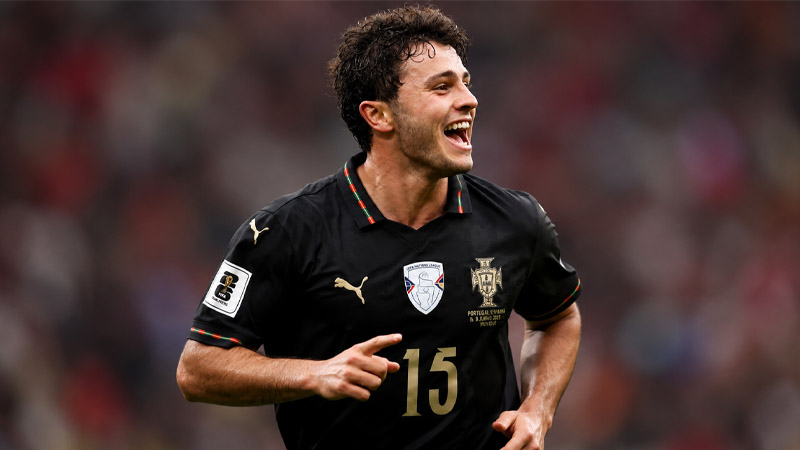
João Neves is a highly complete, dynamic central midfielder who has rapidly emerged as a cornerstone for both Paris Saint-Germain and the Portugal national team.
His multifaceted profile bridges the gap between traditional defensive stability and modern creative flair.
By blending technical press-resistance with an elite defensive work rate, Neves offers a rare versatility that makes him indispensable in high-stakes European football.
Understanding his specific tactical identity requires looking past his stature and into the sophisticated mechanics of his playstyle, which mirrors legends of the game while introducing entirely new dimensions to the central midfield role.
The Dual Identity: Playmaker and Box-to-Box Powerhouse
As a player who operates primarily as a deep-lying playmaker or a high-volume box-to-box midfielder, Neves represents the evolution of the modern “Number 8”.
The Architect in Deep Positions
When deployed as a deep-lying playmaker, Neves serves as the primary engine for team transitions.
His ability to sit in front of the defensive line and dictate the tempo of the game is reminiscent of elite controllers who prioritize ball retention and progressive movement. He does not merely pass the ball; he orchestrates the entire rhythm of the buildup phase.
By ranking among the elite in Europe for chance creation, he demonstrates that a deep position does not limit offensive output.
His passing range is expansive, allowing him to mix high-velocity short passes that bypass the first line of pressure with excellent long-ball switches that immediately change the point of attack for his team.
The Relentless Box-to-Box Presence
Beyond his creative duties, Neves excels in a box-to-box capacity, utilizing his stamina to influence both ends of the pitch.
In this role, he is responsible for carrying the ball forward and supporting the attacking unit while maintaining the discipline to track back during defensive transitions.
This hybridity allows managers to use him in various tactical setups without losing balance.
Whether he is arriving late in the final third or recycling possession in the middle third, his high-volume activity ensures that his team remains dominant in central zones throughout the ninety minutes of play.
Technical Mastery and Press-Resistance
The hallmark of Neves’ game is his incredible press-resistance, a trait that allows him to thrive in the congested spaces of modern elite football.
Escaping the High Press
Standing at 1.74m, Neves utilizes an incredibly low center of gravity to his advantage. This physical trait, combined with quick body orientation, allows him to protect the ball effectively against larger opponents.
When receiving possession under heavy opposition pressure, he does not panic; instead, he executes sharp, seamless turns to escape tight spaces.
This “escape artistry” is critical for a team like Paris Saint-Germain, which often faces deep blocks and aggressive man-marking schemes.
By turning a high-pressure situation into a progressive passing opportunity, Neves acts as a pressure-release valve for his teammates.
Ball Protection and Orientation
His technical finesse extends to how he prepares to receive the ball before it even reaches his feet. Neves is constantly scanning the pitch, which informs his body orientation.
By positioning himself to shield the ball immediately upon contact, he makes it nearly impossible for defenders to dispossess him without committing a foul.
This level of technical security is what draws frequent stylistic comparisons to players like Marco Verratti, who was renowned for his ability to hold onto the ball in the most precarious areas of the pitch.
The Defensive “Bulldog”: Tenacity and Intelligence
Despite his technical brilliance, Neves is far from a luxury player; his defensive contributions are as significant as his playmaking abilities.
| Defensive Attribute | Tactical Impact | Comparison Profile |
|---|---|---|
| Recovery Pace | High-speed tracking back to stifle counter-attacks | N’Golo Kanté |
| Interceptions | Cutting passing lanes through elite spatial awareness | Marco Verratti |
| Duel Aggression | Stepping into physical battles with high intensity | Defensive “Bulldog” |
| Tactical IQ | Identifying and neutralizing threats before they develop | Elite DM |
While he may have a smaller frame, Neves plays with the tenacity of a defensive “bulldog”. He tracks back relentlessly, ensuring that his defensive line is never left exposed during a transition.
His defensive game is built on a foundation of tactical intelligence; he understands where the ball is going before the opponent makes their move.
This allows him to cut passing lanes effectively and regain possession without always needing to make a sliding tackle.
When he does engage in physical duels, he does so with high aggression, often surprising larger players with his strength and determination to win back the ball.
The Aerial Anomaly: Defying Physical Expectations
One of the most fascinating aspects of João Neves’ profile is his ability to dominate in the air despite being one of the shortest players on the pitch.
Elite Vertical Leap
This unique quirk of his profile is a result of remarkable heading ability and elite vertical timing. Neves possesses a “spring” in his jump that allows him to compete with players who have a significant height advantage.
This is not just a defensive asset; his timing makes him a threat during offensive set pieces as well.
The ability to outjump a center-back or win a crucial header in the midfield to retain possession adds a layer of unpredictability to his game that few midfielders of his stature possess.
Strategic Importance of Aerial Wins
Winning aerial duels in the center of the park is often the difference between starting a counter-attack and defending one. Neves regularly wins these duels, ensuring that his team maintains territorial control.
His capacity to score headed goals further highlights his comprehensive skillset, proving that he is a threat in every phase of the game.
This aerial prowess, combined with his ground-level tenacity, creates a player who is physically “larger” than his height suggests, forcing opponents to account for him in ways they typically wouldn’t for a player of 1.74m.
Tactical Versatility and Global Impact
Neves is a highly versatile asset who can adapt to various managerial philosophies and tactical demands.
Role in the Double Pivot
Neves is arguably most destructive when deployed in a double pivot or as a deep central midfielder. In a two-man midfield, he has the freedom to dictate the buildup phase while remaining active in breaking up opposition counter-attacks.
This role requires a perfect balance of discipline and creativity—traits that Neves has demonstrated consistently.
His partnership with other midfielders is often characterized by a “fluid exchange,” where he can alternate between being the primary ball-winner and the primary progressor depending on the game state.
Influence at Club and International Level
Whether representing Paris Saint-Germain in Ligue 1 or the Portugal national team on the international stage, Neves maintains a consistent level of performance. His ability to integrate into different systems speaks to his high footballing IQ.
At the club level, he provides the technical security needed for a possession-based side, while for his country, he offers the energy and grit required for tournament football.
This global relevance makes him one of the most sought-after young profiles in the world, as he fits the mold of the “complete” modern midfielder that elite clubs prioritize.
Enhanced FAQ: Understanding the Neves Phenomenon
What makes João Neves different from other young midfielders?
The primary differentiator is his “complete” profile. While many young players excel either technically or defensively, Neves combines elite press-resistance and playmaking with a “bulldog” defensive work rate and a surprising aerial presence.
Which legendary players is João Neves often compared to?
His style is frequently compared to N’Golo Kanté for his relentless work rate and defensive aggression, and to Marco Verratti for his low center of gravity and world-class press-resistance.
Can João Neves play as a traditional Number 6?
Yes, he is highly effective as a deep central midfielder. While he has the engine of an 8, his tactical intelligence and ability to dictate tempo from deep allow him to thrive as a 6, especially in a double pivot where he can share defensive responsibilities.
How does Neves perform in the air despite his height?
It is considered a unique quirk of his profile. His success in the air is attributed to elite timing and a remarkable vertical leap, allowing him to win duels against much taller opponents and even score headed goals.
The Future of the Midfield Engine
The rise of João Neves signals a shift in what elite teams look for in a central midfielder. No longer satisfied with specialists who only tackle or only pass, the modern game demands players who can “do it all.” Neves is the personification of this trend.
His blend of technical artistry and defensive grit creates a player who can dominate the middle of the pitch regardless of the opposition’s style.
As he continues to mature at Paris Saint-Germain and within the Portuguese national setup, his influence on the global stage is only set to increase.
For any tactical system that relies on high-tempo transitions and maintaining possession under pressure, Neves is the ideal solution. He is not just a prospect; he is a finished article in many ways, providing a level of maturity and tactical discipline that belies his age.
As the “engine” of his teams, he ensures that the transition from defense to attack is seamless, and the defensive shield remains unbreakable.
Watching Neves is a masterclass in how a player can use intelligence and technique to overcome physical limitations, ultimately redefining what it means to be a complete midfielder in the 21st century.