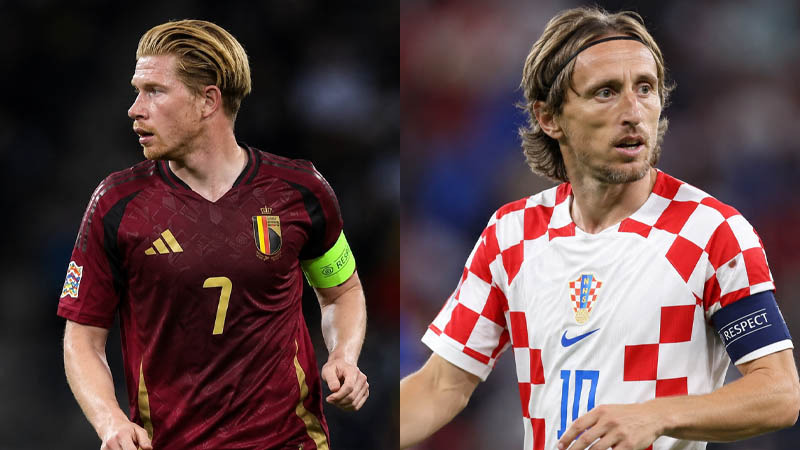
The debate between Kevin De Bruyne and Luka Modrić represents the pinnacle of modern footballing analysis. As of June 2026, both legends have transitioned into the Italian top flight to cement their enduring legacies.
De Bruyne currently orchestrates play for SSC Napoli at age 34, while the 40 year old Modrić remains a vital anchor for AC Milan. This comparison transcends simple statistics by examining the conflict between high volume attacking output and total game control.
By analyzing their tactical evolution, international contributions, and head to head metrics, we can define their unique places in football history.
The Definitive Career Statistics: Output and Endurance
Numbers provide the essential foundation for any comparison between these two maestros. While they often share the same central areas of the pitch, their primary metrics highlight a stark division in their footballing philosophies.
One player focuses on the clinical destruction of defensive blocks through direct involvement. The other prioritizes the structural integrity and rhythm of his team over several decades of elite competition.
The following table summarizes their senior career totals including club and international matches as of mid 2026.
| Career Metric | Kevin De Bruyne | Luka Modrić |
|---|---|---|
| Total Senior Appearances | 773 | 1,090 |
| All-Time Senior Goals | 192 | 125 |
| All-Time Senior Assists | 316 | 172 |
| Total Goal Contributions | 508 | 297 |
| Goal Involvement Rate | 0.66 per game | 0.27 per game |
Efficiency and Final Third Aggression
Kevin De Bruyne operates with a level of efficiency that is nearly unprecedented for a central midfielder. Despite playing roughly 300 fewer games than his Croatian counterpart, he has produced significantly more goals and assists.
His rate of 0.66 goal involvements per game marks him as a high risk and high reward creative machine. This statistical profile suggests he is the primary engine for teams that prioritize rapid transition and chance creation.
Evergreen Longevity and Defensive Contributions
Luka Modrić displays a metric of endurance that is rare in the history of the sport. His 1,090 appearances reflect more than two decades at the absolute peak of European competition.
While his direct scoring numbers are lower, his impact is felt through ball retention and rhythm manipulation. He often acts as the deep lying bridge between the defense and the attack where direct assists are less common.
Tactical Philosophies: The Architect Against the Conductor
The stylistic differences between these players are best summarized as a clash between the Architect and the Conductor. Each player fulfills a specific tactical requirement that dictates how an entire squad functions on the pitch.
Their roles have evolved over time to suit the demands of different managers and systems. Understanding these nuances is key to appreciating why they are both considered generational geniuses.
De Bruyne: The High Risk Creative Engine
Kevin De Bruyne acts as the Architect by designing and executing complex attacking sequences in the final third. He is widely recognized for his explosive power and the ability to deliver lethal crosses from the inside channels.
His vision allows him to attempt defense splitting passes that others might find too risky. This aggressive style of play is intended to break matches open and provide constant pressure on the opposition goal.
Modrić: The Press Resistant Rhythm Controller
Luka Modrić serves as the Conductor by dictating the tempo and maintaining the shape of his team. He is world famous for his low center of gravity and incredible press resistance.
Modrić uses his spatial awareness to shield the ball flawlessly under heavy pressure from opponents. This allows his team to maintain composure and build play from the back with total security.
Defensive Versatility and Physical Attributes
It is a misconception to assume that either player is limited to a single phase of the game. De Bruyne stands at 1.81 meters and uses his larger frame to transition ball possession rapidly through physical power.
During his time at Manchester City, he demonstrated outstanding defensive work rates when playing deeper roles to cover for teammates. Modrić relies on agility and his signature outside of the boot pass to escape tight situations.
Individual Achievements: Ballon d’Or and Major Honors
The trophy cabinets of these two players reflect their dominance in the modern era. While both have won almost everything available at the club level, their individual accolades distinguish them in the history books.
One has achieved the ultimate individual prize in world football. The other has been the defining player of the most dominant league on the planet for nearly a decade.
Luka Modrić: The Golden Ball and European Glory
Luka Modrić holds a distinct advantage when it comes to major European team honors and individual recognition. He famously broke the Messi and Ronaldo monopoly to win the Ballon d’Or in 2018.
His career includes an astounding six UEFA Champions League titles, primarily with Real Madrid. This success cements his status as a player who thrives in the most pressurized knockout environments in the world.
Kevin De Bruyne: Domestic Dominance and the Treble
Kevin De Bruyne has defined the standard for excellence in the English Premier League. He captured six league titles and was twice named the Premier League Player of the Season.
His crowning achievement came in 2023 when he led Manchester City to a historic European treble. While he lacks a Ballon d’Or, his consistency as the world’s premier playmaker for over six years is a testament to his quality.
Head to Head: When the Titans Collide
Direct matchups provide a unique perspective on which player exerts more influence when they share the same pitch. These encounters have taken place across various elite competitions involving both clubs and national teams.
The data from these 16 matches suggests a slight statistical edge for one of the maestros. However, the overall results remain exceptionally close between their respective sides.
Direct Matchup Results and Statistics
In their 16 head to head meetings, De Bruyne has secured 7 victories compared to 5 for Modrić. There have also been 4 draws between their teams during these high stakes encounters.
- Total Matches: 16
- De Bruyne Wins: 7
- Modrić Wins: 5
- Draws: 4
Individual Output in Direct Competitions
The individual output during these matches reveals a significant gap in direct involvement. Kevin De Bruyne has registered 5 goals and 4 assists when facing Modrić on the pitch.
In contrast, Modrić has recorded zero goals and zero assists in these specific 16 games. This indicates that De Bruyne often finds ways to remain decisive even against an elite controller.
International Legacy: Leading Golden Generations
Both players serve as legendary captains for their countries and have carried the creative burdens of their national teams. They have each led their nations through the most successful periods in their respective histories.
Their international careers are defined by their ability to elevate the performance of those around them. This is particularly true during the intense environment of the FIFA World Cup.
The Croatian Hero: Overachieving on the World Stage
Luka Modrić guided the Croatian national team to heights that few thought possible. He led them to the World Cup Final in 2018 and secured a Bronze medal in 2022.
His leadership was also evident as Croatia reached the UEFA Nations League final in 2023. He has earned nearly 200 caps for his country, making him the undisputed icon of Croatian football.
The Belgian Engine: Sustained Excellence
Kevin De Bruyne was the heartbeat of the Belgian side that reached the number one spot in the FIFA World Rankings. He earned a World Cup Bronze medal in 2018 during Belgium’s most successful tournament run.
He has registered 37 international goals, which is a higher tally than Modrić despite playing significantly fewer matches. His ability to produce goals for his country has remained consistent for over a decade.
Longevity and the Italian Chapter: 2026 Perspectives
The move to Serie A in 2025 marked a new phase for both players as they entered the final years of their professional careers. This transition highlights their different approaches to aging in a highly tactical league.
One player has adapted by moving into a team known for attacking fluidity. The other has joined a historic club to provide stability and veteran leadership.
De Bruyne at Napoli: A New Creative Hub
At age 34, Kevin De Bruyne joined SSC Napoli to bring his elite vision to the Italian top flight. His move was seen as a way to maintain his attacking output in a league that often rewards technical intelligence over pure pace.
He continues to be a primary threat in the final third for the Partenopei. His contract is set to run until 2027, suggesting he remains a long term centerpiece of their project.
Modrić at Milan: The 40 Year Old Anchor
Luka Modrić signed with AC Milan in 2025 to serve as a deep lying anchor for the Rossoneri. At age 40, his ability to read the game and control the midfield remains at a world class level.
Despite AC Milan missing out on European competitions recently, Modrić has continued to provide a masterclass in professional endurance. His current agreement is a shorter term commitment that reflects his year by year approach to the game.
Professional Verdict: Who is the Better Midfielder?
Choosing between these two legends requires an understanding of what a specific team needs to win. There is no objective answer that applies to every tactical scenario or footballing system.
The following points summarize the final considerations for this generational debate based on career long performance.
- Direct Impact: Choose De Bruyne for elite goal creation, final third aggression, and match winning moments through assists and long range strikes.
- Total Control: Choose Modrić for dictating play, escaping high pressure situations, and maintaining team composure over a 90 minute period.
- Longevity: Modrić has proven to be the ultimate professional by maintaining an elite level of fitness well into his late thirties and early forties.
- Trophies: Modrić holds the edge in major European honors and the prestigious Ballon d’Or award.
Frequently Asked Questions
Is De Bruyne statistically better than Modrić?
In terms of direct goal contributions, yes. De Bruyne has over 500 total goals and assists in 773 games, while Modrić has 297 contributions in 1,090 games. De Bruyne’s involvement rate of 0.66 per game is far higher than Modrić’s 0.27.
Who has more Champions League titles?
Luka Modrić has won six UEFA Champions League titles, all with Real Madrid. Kevin De Bruyne won his first Champions League title as part of Manchester City’s treble in 2023.
Can they play together in the same midfield?
Yes, they would likely be highly complimentary as they perform different roles. Modrić would sit at the base of the midfield to control the game, while De Bruyne would operate further forward to decide the game with final passes.
Why is Modrić still playing at age 40?
Modrić relies on spatial awareness and technical skill rather than physical speed or strength. His ability to avoid pressure and his efficient movement allow him to compete in elite leagues like Serie A even at an advanced age.
What are their current clubs in 2026?
Kevin De Bruyne is currently playing for SSC Napoli in Italy. Luka Modrić is playing for AC Milan, where he has been since the summer of 2025.