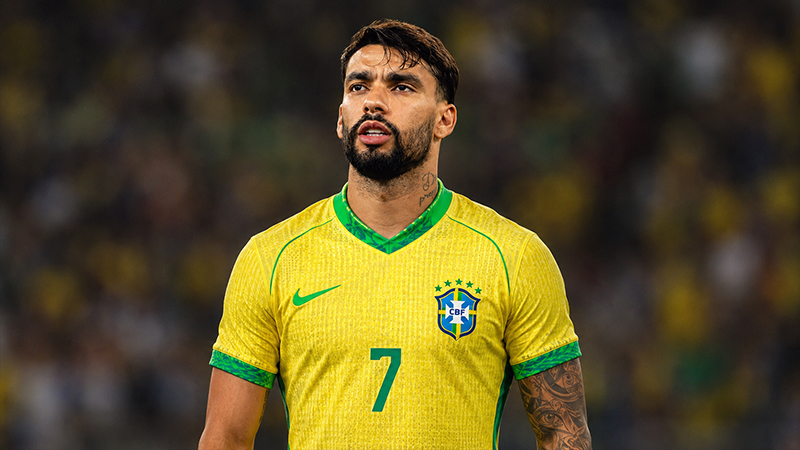
Lucas Paquetá is an exceptionally talented, elite playmaker who operates with a classic Brazilian flair, though his career has often been a blend of world-class magic and positional frustration.
Standing at 180 cm, the 28-year-old left-footed midfielder is highly technical, immensely strong under pressure, and remarkably hardworking defensively for a creative player.
From his record-breaking €42 million move to Flamengo to his influential yet statistically polarizing tenure at West Ham, his value is a subject of intense debate among fans and analysts.
Understanding how good he truly is requires looking beyond basic metrics to the emotional and tactical core of his game.
The Technical Blueprint: Why Paquetá is an Elite Playmaker
To appreciate the quality of Lucas Paquetá, one must analyze the intersection of his physical attributes and his technical mastery of the ball. He is not a traditional, stationary “number 10,” but rather a dynamic force who can influence multiple phases of play.
Elite Vision and Progressive Passing
Paquetá possesses a rare ability to split defenses with “eye-of-the-needle” through balls that change the geometry of an attack in an instant.
His left foot is a precision instrument, allowing him to deliver a varied and highly effective crossing profile from both wide and central areas.
This technical range was famously on display during his historic assist in the 2023 Europa Conference League Final, a moment that cemented his legacy in East London.
His vision is not just about the final pass; it is about his ability to see the “pass before the pass,” orchestrating the tempo of the entire team.
Press Resistance and Physicality
One of his most underrated traits is his immense strength under pressure and his world-class press resistance. Paquetá excels at using his 180 cm frame to shield the ball, effectively shrugging off defenders even when swarmed in tight midfield spaces.
This physical robustness allows him to retain possession where other flair players might be dispossessed, making him a vital outlet for transitioning from defense to attack.
He is a player who thrives in the chaos of a high-press environment, often finding an elegant solution to escape heavy traffic.
The Defensive Grit of a Flair Player
Unlike many creative maestros who are often criticized for a lack of defensive effort, Paquetá is remarkably hardworking.
He genuinely enjoys the defensive side of the game, frequently tracking back to tackle and winning crucial aerial duels in his own defensive box.
This “box-to-box” mentality makes him a unique asset, as he provides the grit of a defensive midfielder alongside the imagination of a playmaker.
His willingness to get “stuck in” is a trait that endears him to managers and teammates alike, even when his offensive output fluctuates.
The Statistical Paradox: Decoding the Performance Data
The question of “how good” Paquetá is often hits a roadblock when looking at raw statistics, which can sometimes appear underwhelming compared to his reputation.
This discrepancy is at the heart of the fan debate regarding his ultimate effectiveness on the pitch.
Comparing League Impact: West Ham vs. Flamengo
During the 2025/2026 season, Paquetá’s performance metrics showed a notable shift as he moved between the Premier League and the Brazilian Série A.
In England, his stats were often criticized by fans who felt his “fancy flicks and tricks” didn’t always result in goals. However, his move back to Flamengo saw an immediate spike in his overall match ratings, suggesting he thrives more in a dominant, fluid system.
| Competition | Team | Appearances | Goals | Assists | Avg Rating |
|---|---|---|---|---|---|
| Premier League | West Ham | 18 | 4 | 1 | 6.78 |
| Brasileirão (Série A) | Flamengo | 11 | 3 | 0 | 7.33 |
| National Team | Brazil | 61 | 12 | – | – |
The Value of Influence Over Output
While he recorded only one assist in 18 Premier League appearances during a recent stretch, his influence on the game often transcends the scoresheet.
Supporters argue that his presence alone elevates the team’s ability to set a tempo and win duels. On the other hand, critics point to his low goal involvement—rarely exceeding four league goals a season—as proof that he “flatters to deceive”.
This conflict highlights the difficulty of quantifying a player whose primary value lies in creative progression and defensive stability rather than just final-third production.
The “Luxury Player” Debate: Asset or Liability?
A recurring theme in discussions about Paquetá is whether he is a “luxury player” or a foundational building block for a winning squad. This debate centers on his tendency to take risks that can sometimes lead to dangerous turnovers.
High Risk, High Reward Playstyle
Paquetá is a player who always tries to do something positive every time he receives the ball, which inevitably leads to him giving possession away more than a “safer” midfielder.
Some fans find this frustrating, especially when he goes to ground easily or tries to buy a foul instead of tracking back after a mistake. This emotional volatility can also lead to “cheap” yellow cards, making him a “yellow card machine” in high-stakes matches.
The Importance of Team Environment
The perception of Paquetá as a luxury player often depends on the quality of the players around him. It has been argued that he was “hamstrung” by a lack of technical quality in the West Ham midfield, which forced him to take on too much individual responsibility.
In contrast, when he plays for the Brazil National Team surrounded by elite talent, he often looks like one of the best midfielders in the world.
This suggests that he is a “multiplier” of talent—he doesn’t necessarily drag a poor team to victory by himself, but he makes a good team significantly more dangerous.
Off-Field Pressures and the Search for Peace
To truly understand Paquetá’s recent form, one must acknowledge the immense psychological burden he has carried over the last two years.
The Impact of Legal and Mental Health Struggles
Paquetá was embroiled in a complex two-year spot-fixing investigation that took a heavy toll on his mental health.
He publicly expressed his frustration over the lack of psychological support from football federations during this time, noting that it was “ridiculous” to have his life and career affected so deeply without help.
This period of “hell” undoubtedly influenced his on-field behavior and consistency.
The Strategic Homecoming to Flamengo
In January 2026, Paquetá made the high-profile decision to return to his boyhood club, Flamengo, in a move worth €42 million (£35.5m). This was not just a transfer for footballing reasons; it was a search for peace and the restoration of his happiness.
By returning to Brazil, he aimed to find the “smile” that makes his game special and to solidify his position as a starter for the upcoming 2026 World Cup.
His early performances in the Brasileirão, where his rating jumped to 7.33, indicate that this return to familiar ground has been a revitalizing force.
The Global Legacy: Paquetá on the World Stage
Despite the debates at the club level, Paquetá’s status within the Brazil National Team remains formidable, with over 61 appearances and 12 goals.
A Vital Piece for the Seleção
In the context of international football, Paquetá is often viewed as a key building block for Brazil’s midfield.
His ability to blend “Joga Bonito” flair with high defensive work makes him indispensable for a team that prioritizes both technical dominance and tactical discipline. He has started in the World Cup and remains a central figure as the team prepares for 2026.
Future Outlook and Career Trajectory
Now 28 years old, Paquetá is in his physical prime. While his market value of €36M might see a decline in resale value as he enters his 30s, his current impact on the pitch remains world-class.
His journey from Milan to Lyon, then to West Ham, and finally back to Flamengo showcases a player who has sought the right environment to flourish technically and emotionally.
If he maintains his current form in the CONMEBOL Libertadores, he will head into the next World Cup as one of the most influential playmakers in the game.
Enhanced FAQ: Everything You Need to Know
Why is Lucas Paquetá called the “Maestro of Joga Bonito”?
He is given this title because he embodies the traditional Brazilian style of play characterized by flair, creativity, and technical grace.
His ability to execute flashy skills while maintaining tactical importance makes him a modern standard-bearer for this historic philosophy.
What was the fee for Paquetá’s transfer to Flamengo?
Flamengo paid a record-breaking €42 million (£35.5m) to bring him back from West Ham in January 2026. This move was driven by the player’s desire to return to his roots and find professional peace.
Is Paquetá a good defensive player?
Yes, surprisingly so. Unlike many attacking midfielders, he has a very high work rate, frequently winning tackles and aerial duels in his own box. This dual-threat capability is one of his most valuable assets for any manager.
How has the legal investigation affected his career?
The two-year investigation into spot-fixing charges significantly impacted his mental health and lead to periods of emotional volatility on the pitch. He has since been cleared and moved back to Brazil to move past this difficult chapter.