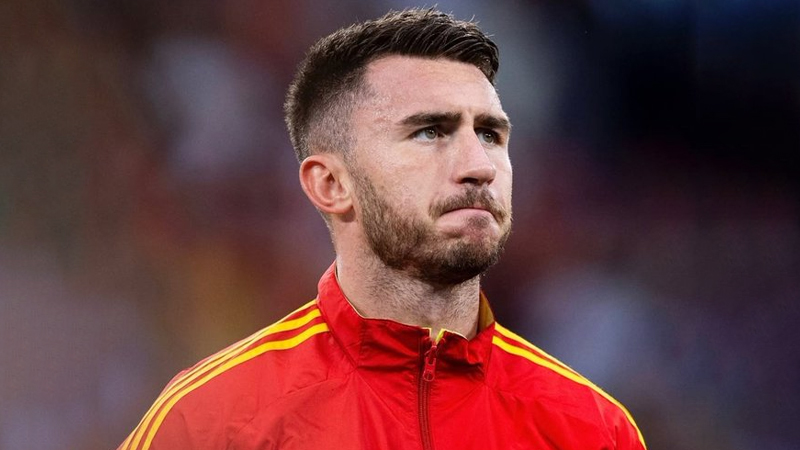
Aymeric Laporte’s departure from Manchester City in August 2023 marked the end of a highly successful five-and-a-half-year tenure. Despite being a cornerstone of the defense for years, the Spanish international finalized a £23.6 million move to Al Nassr.
His exit left fans questioning why a world-class defender in his prime would leave a treble-winning squad for the Saudi Pro League.
The answer lies in a combination of reduced playing time, tactical shifts under Pep Guardiola, and the arrival of elite competition. Ultimately, Laporte sought a fresh start where his role as a guaranteed starter would be restored.
The Core Reason: A Decline in Regular Minutes
The primary driver behind Laporte’s exit was a significant reduction in his role within the squad. During Manchester City’s historic 2022–23 campaign, which saw the club secure a continental treble, Laporte found himself increasingly marginalized on the bench.
He started only 11 Premier League matches throughout that season, as Pep Guardiola began to favor other defensive configurations that better suited his evolving tactical needs.
For a player of Laporte’s caliber, entering his prime years meant that remaining a secondary option was untenable. This sentiment was echoed by the club’s leadership.
Manchester City’s Director of Football, Txiki Begiristain, explicitly noted that the club facilitated the transfer because they could no longer guarantee the “sufficient game time” Laporte required to maintain his professional standards.
The move was not a reflection of a lack of quality, but rather a mutual acknowledgement that the player’s personal career goals were no longer aligned with the club’s current selection hierarchy.
Rising Competition in Guardiola’s Defensive Unit
Laporte’s struggle to maintain a starting spot was exacerbated by the exceptional form of his teammates. Following his return from knee surgery, he found himself behind a defensive line that was performing at an unprecedented level.
The Impact of Internal Defensive Depth
The emergence of Rúben Dias as a vocal leader and the tactical versatility of players like John Stones and Nathan Aké made it difficult for Laporte to reclaim his position.
Stones’ transition into a hybrid midfield role and Aké’s reliability on the left side of a back three provided Guardiola with flexibility that Laporte’s profile did not always offer.
Furthermore, the arrival of Manuel Akanji, who proved to be an incredibly consistent and cost-effective performer, added another layer of competition that pushed Laporte further down the pecking order.
The Arrival of Josko Gvardiol
The final confirmation that Laporte’s opportunities would be limited came during the summer transfer window of 2023. Manchester City completed the signing of Josko Gvardiol from RB Leipzig for a reported £77 million.
As a younger, highly-rated left-footed center-back, Gvardiol was seen as the future of the City defense. Given that Guardiola is often reluctant to play two left-footed central defenders together, Gvardiol’s arrival effectively signaled that Laporte would fall to fifth or sixth choice in the defensive rotation.
Tactical Misalignment and Positional Frustration
Beyond mere minutes, Laporte’s dissatisfaction was rooted in how he was utilized when he did play. In his final two seasons, tactical adjustments saw him frequently deployed as a left-back rather than in his preferred central role.
While his technical ability allowed him to perform there, Laporte reportedly found this shift highly frustrating, as it did not maximize his greatest strengths as a ball-circulating center-half.
The Evolution of the “Inverted” System
Guardiola’s shift toward using four natural center-backs across the defensive line often required one or two of them to operate in wide areas or push into midfield.
| Feature | Laporte’s Preferred Role | City’s Tactical Shift |
|---|---|---|
| Position | Central Defense (Left Side) | Left-Back or Wide Center-Back |
| Responsibility | Deep Playmaking/Coverage | Hybrid Midfield/Wide Defensive Duty |
| Preferred Foot | Left | Multiple players used for balance |
While Laporte was excellent at progressive passing, the physical demands of the “Aké role” on the left flank were less suited to his style, leading to a disconnect between his skillset and the team’s immediate tactical requirements.
Completion of a Trophy-Laden Cycle
At the time of his departure, Laporte had achieved almost everything possible in English and European football. Over his five-and-a-half seasons at the Etihad, he accumulated 13 major trophies.
- 5 Premier League Titles
- 1 UEFA Champions League
- 2 FA Cups
- 3 Carabao Cups
- 1 UEFA Super Cup
- 1 FIFA Club World Cup
Having been a “massive part” of the squad that achieved a Premier League three-peat and the long-awaited Champions League title, Laporte felt his cycle in Manchester was complete.
He left the club not as a failure, but as a legend who had reached the summit of the sport and was now looking for a fresh challenge in a different environment.
Market Realities and the Move to Al Nassr
One of the more surprising aspects of Laporte’s exit was his move to the Saudi Pro League instead of another elite European club. While he remained a “class player,” several factors limited his options within the European market.
A Lack of Champions League Offers
Despite his pedigree, reports suggested there was surprisingly little interest from clubs participating in the UEFA Champions League at the time of his sale.
While teams like Tottenham Hotspur, Aston Villa, and Crystal Palace were linked with him, none of the traditional European giants made a definitive move.
Financial Barriers and High Wages
Laporte’s salary at Manchester City was significant, reflecting his status as a top-tier defender.
Many European clubs that might have needed a center-back were unable or unwilling to match his wage demands, especially following the financial impact of the COVID-19 pandemic on club budgets.
Al Nassr’s ability to offer a lucrative contract while meeting City’s valuation made the move to Saudi Arabia the most viable path forward for all parties involved.
The Human Element: Injuries and Personal Factors
The narrative of Laporte’s departure is incomplete without mentioning the physical and personal toll of his final years in England. He was often described as a “forgotten hero” who sacrificed his long-term health for the club’s success.
A defining moment for many fans was his performance during the 2021–22 title run, where he played through a serious knee injury to ensure City crossed the finish line ahead of Liverpool.
This sacrifice earned him immense respect from the fanbase but also took a toll on his body, leading to a difficult recovery period that allowed others to take his spot in the team.
Additionally, rumors from Spain suggested that Laporte, much like teammate Bernardo Silva, had struggled with being away from home during the pandemic and found the lifestyle in England challenging.
These personal factors, combined with the professional desire for a guaranteed starting role, created a situation where a move away from the Premier League became the most attractive option for his overall well-being.
Legacy of the “Rolls Royce” Defender
Aymeric Laporte leaves Manchester City with a reputation as one of the most technically gifted defenders to ever wear the shirt. Often described as a “Rolls Royce” of a player, his ability to break lines with his passing was instrumental in the early years of the Guardiola era.
He was the first truly great central defender signed to partner with Vincent Kompany, and he remained a pillar of the team’s success for over half a decade.
Though his final season was spent largely in the background, his contribution to the club’s dominance cannot be overstated.
He was a massive part of the defensive foundation that allowed City to win five titles in six years, and his departure represents the natural evolution of a squad that must constantly renew itself to stay at the top.
Frequently Asked Questions
Why did Manchester City sell Aymeric Laporte for only £23.6 million?
The fee reflected a combination of Laporte’s age (29 at the time), his desire to leave for more playing time, and the club’s general policy of not standing in the way of players who no longer wish to be there.
Additionally, the lack of competing bids from wealthy European clubs influenced the final valuation.
Did Laporte have a falling out with Pep Guardiola?
There is no official evidence of a personal “fallout” similar to the one experienced by Joao Cancelo. However, there was clear tactical friction regarding Laporte’s playing time and his use out of position at left-back, which ultimately led to a mutual decision to part ways.
Which Saudi club did Aymeric Laporte join?
Laporte joined Al Nassr, where he teamed up with other former European stars like Cristiano Ronaldo and Sadio Mané.
How many trophies did Laporte win at Manchester City?
He won 13 major trophies, including five Premier League titles and the UEFA Champions League.
Conclusion: A Strategic Realignment
The departure of Aymeric Laporte was a textbook example of a high-level strategic realignment. For Manchester City, it allowed the club to integrate younger talent like Josko Gvardiol and maintain a squad of players fully committed to their specific roles.
For Laporte, it provided a necessary escape from a bench-warming role and offered a new chapter in a burgeoning league.
While fans may feel a sense of loss seeing such a talented defender leave the European stage, his legacy at the Etihad is secure. He will be remembered not just for his trophies, but for the poise, technical brilliance, and physical sacrifice he gave to the club during its most successful era.
As Manchester City continues to evolve, the “Rolls Royce” of defenders will remain a key figure in the story of their ascent to global footballing dominance.