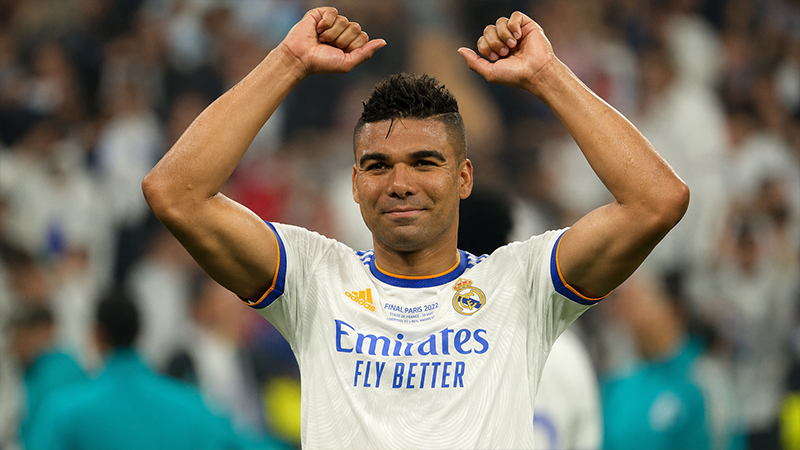
In the final weeks of the August 2022 transfer window, the football world witnessed a transaction that defied the typical logic of elite-level player movement.
Carlos Henrique Casemiro, the defensive anchor of a Real Madrid side that had just secured its fourteenth European Cup, elected to depart the Santiago Bernabéu.
This was not a player being discarded, nor was it a star in decline; it was a calculated, strategic pivot by one of the most decorated midfielders in the history of the sport.
To understand why a cornerstone of the “Bermuda Triangle”—the legendary midfield trio of Kroos, Casemiro, and Modrić—would choose to exchange the stability of the Spanish capital for a rebuilding project in the English Premier League, one must look beyond the surface-level headlines.
This move was the result of a convergence of professional ambition, fiscal foresight, and organizational evolution.
The Pursuit of a New Professional Horizon
For a professional who has reached the absolute zenith of their field, the greatest risk is often stagnation. By the summer of 2022, Casemiro’s resume was effectively exhaustive.
Having secured five Champions League titles and domestic dominance in Spain, he had reached a point of total accomplishment at Real Madrid.
At 30 years old, an age often considered the transition point into the “veteran” phase of a career, he faced a choice: remain in a familiar ecosystem or seek a final, high-stakes challenge in a different environment.
The “New Career Challenge” was a primary driver for this transition. Casemiro expressed a distinct desire to test his tactical and physical capabilities in the Premier League—a division known for its high intensity and different officiating style.
Beyond the pitch, his motivations were deeply personal and growth-oriented. He sought the “Human Element” of the move, specifically citing a strong desire to learn a new language and immerse himself in a different culture.
This reflects the mindset of a global professional looking to expand his personal brand and skill set outside of his native Portuguese and adopted Spanish.
Furthermore, the mission at Manchester United provided a narrative arc that Real Madrid could no longer offer: the opportunity to be a primary catalyst for a club’s restoration. His goal was not just to play, but to help bring Manchester United back to a level where they could consistently compete for major titles.
Strategic Fiscal Management and Long-Term Security
In any Fortune 500-level organization, long-term planning and risk mitigation are paramount. The transfer to Manchester United represented a masterclass in career-end financial planning for the player.
Real Madrid maintains a well-documented policy regarding aging players. Historically, the club is reluctant to offer extended, high-paying contracts to athletes once they surpass the age of 30.
As the club began to refresh its midfield, the likelihood of Casemiro receiving a long-term deal that matched his perceived value was diminishing.
Manchester United, conversely, presented an offer that prioritized “Long-Term Security”. The contract featured:
- A Lucrative Four-Year Term: Providing stability through his mid-30s.
- An Option for a Fifth Year: Extending his earning potential and influence.
- Significant Wage Increase: A deal that substantially increased his earnings compared to his previous arrangement in Madrid.
For Casemiro, this was a logical step toward securing his financial future while his market value remained at its peak. It allowed him to exit on high terms rather than waiting for his contract to dwindle alongside his playing time.
The Organizational Shift: Real Madrid’s “Changing of the Guard”
One of the most critical factors in any successful separation is the preparedness of the organization left behind. Real Madrid did not stand in Casemiro’s way, largely because they had already initiated their succession plan.
The signing of Aurélien Tchouaméni was the definitive signal that the “Changing of the Guard” was underway. With a younger, high-potential successor already integrated into the squad, the club could afford to let a legend depart without compromising their competitive integrity. This organizational readiness allowed the transition to be amicable.
Because of his status as a “serial winner” and a club legend, Real Madrid’s leadership granted him the autonomy to leave on his own terms. This is a rare occurrence in elite sports, where players are often sold when their value drops or kept against their will to satisfy short-term goals.
In this instance, the interests of the player (who wanted a new challenge and security) and the club (who wanted to integrate youth and recoup a significant transfer fee) were perfectly aligned.
Impact Analysis: The Legacy and the Mission
Casemiro’s departure was more than a transfer; it was a statement of intent for his final peak years. By choosing Manchester United, he accepted the pressure of a “leadership-heavy” role.
In Madrid, he was one of many icons; in Manchester, he was recruited to be the icon who would define the standard of professionalism in the locker room.
The move also highlighted his confidence. To leave a winning machine for a team in transition at age 30 requires a level of self-belief that is common among top-tier executives and elite athletes alike.
He was not looking for a “retirement tour”; he was looking to export the “winning DNA” he developed in Spain to a league that prides itself on being the most competitive in the world.
Analytical FAQ: Understanding the Transition
Why did Casemiro leave after winning the Champions League?
The timing was strategic. Having won five titles, there was a sense of “mission accomplished”. Leaving at the peak of his powers allowed him to command a higher salary and a longer contract than if he had waited for his performance to decline.
Was the move purely financial?
No. While the contract was “highly lucrative” and provided “long-term financial security,” the player also emphasized the sporting challenge and the personal growth associated with learning a new language and culture.
Did Real Madrid want him to stay?
The club was “happy to keep him,” but they were also pragmatic. They recognized his desire for a new chapter and, with Tchouaméni ready to take his place, they respected his status as a legend and allowed him to exit gracefully.
What were the primary goals of the move for the player?
The goals were three-fold: test himself in a different league, secure his financial future through his mid-30s, and help lead Manchester United back to trophy-winning status.
Conclusion: A Strategic Masterstroke
The transition of Casemiro from Madrid to Manchester serves as a case study in professional autonomy.
By recognizing the internal shift at Real Madrid—symbolized by the arrival of younger talent—and weighing it against a life-changing offer from Manchester United, Casemiro took control of his career trajectory.
He traded a comfortable, familiar excellence for a rigorous, uncertain, but ultimately rewarding new chapter.
This move ensured that his legacy at Real Madrid remained untarnished, leaving as a champion, while simultaneously positioning him as a foundational figure in a new era for one of England’s most historic clubs.