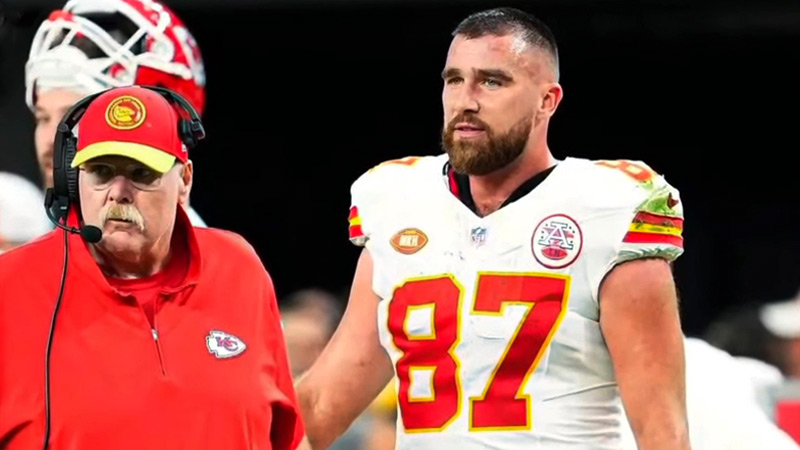
In the high-stakes, high-emotion world of the NFL, few players command as much attention as Travis Kelce. Between his record-breaking statistics on the field and his massive cultural footprint off of it, every move the Kansas City Chiefs’ tight end makes is scrutinized by millions.
Among the most frequent questions fans and critics alike ask is: “Why did Travis Kelce get suspended?”
The answer to that question is both simpler and more nuanced than many fans realize. While Kelce has a reputation for playing with a “fire” that occasionally boils over, the factual record of his professional career tells a very specific story about his relationship with league discipline.
The Fact Check: Has Travis Kelce Ever Been Suspended?
To address the central question immediately: Travis Kelce has never been suspended by the NFL. Despite his intense playing style and several high-profile clashes with officials, he has never been barred from subsequent games for disciplinary action by the league office.
This fact often surprises casual observers because Kelce is frequently involved in the kind of “chippy” play and vocal disagreements that lead to penalties. However, throughout his decade-plus career in the NFL, he has maintained a remarkable record of availability.
While other stars have missed time for various infractions, Kelce has managed to keep himself on the active roster, avoiding the “suspended” list entirely.
The Infamous 2016 Ejection: The “Towel Throw” Incident
If Kelce has never been suspended, where does the rumor come from? Most of the confusion stems from a 2016 matchup against the Jacksonville Jaguars.
This game provided one of the most memorable—and meme-worthy—moments of Kelce’s career, and it remains the closest he has ever come to a multi-game disciplinary action.
The Conflict and the Missed Call
The incident began when Kelce became incensed over what he perceived to be a missed pass interference penalty.
In the heat of the game, Kelce felt that the defender had illegally contacted him, preventing a catch. When the officials did not throw a flag, Kelce’s frustration reached a breaking point.
The Escalation
Kelce began arguing aggressively with the officiating crew. This initial outburst resulted in his first unsportsmanlike conduct penalty. In many cases, a player might take the hint and walk away, but Kelce’s competitive drive led him to double down.
The “Flagging” of the Official
In a moment of pure sarcasm that immediately went viral, Kelce reached for his own white towel and threw it at an official in a “flagging” motion.
He was essentially “penalizing” the referee for his performance. The act was seen as a direct challenge to the authority of the officiating crew.
The Automatic Ejection
Under NFL rules, a player who receives two unsportsmanlike conduct penalties in a single game is subject to an automatic ejection. Because the towel throw followed his initial argument, the referees had no choice but to remove him from the game.
Kelce was forced to leave the field, leaving his team without their primary offensive weapon for the remainder of the contest.
The Financial Consequences: Fines vs. Suspensions
While the NFL opted not to suspend Kelce for the towel-throwing incident, they did not let the behavior go unpunished. The league is notoriously protective of its officials and takes any physical or symbolic “attack” on them seriously.
Following the game, the NFL reviewed the footage and handed down a significant financial penalty. Kelce was fined $24,309 for the outburst. To many fans, a five-figure fine feels like a massive punishment, but in the context of NFL discipline, it is a “slap on the wrist” compared to a suspension.
A suspension would have resulted in the loss of a full game check—which for a star of Kelce’s caliber is significantly higher than $24,000—and would have impacted his team’s ability to win their next game.
Why the “Suspension” Myth Persists
There are several reasons why the public often incorrectly remembers Kelce as having been suspended:
- The Visual Impact of the Ejection: Seeing a star player pointed toward the locker room by an official is a jarring image. For many fans, an ejection feels the same as a suspension, even though an ejection only affects the current game while a suspension affects future ones.
- His “Bad Boy” Reputation: Early in his career, Kelce was often labeled as a “hothead.” His tendency to celebrate boisterously and argue with opponents created a narrative that he was a “loose cannon,” making it easier for people to believe the league had sidelined him.
- High-Profile Fines: Kelce has been fined multiple times throughout his career for various infractions, including taunting and late hits. While these fines are common in the NFL, they are often reported in sports media alongside news of player suspensions, which can blur the lines for the average reader.
The “Ironman” Availability
One of the most impressive aspects of Travis Kelce’s career is his availability. In a league where “the best ability is availability,” Kelce has been a constant presence for the Kansas City Chiefs. By avoiding the suspension list, he has ensured that he is on the field for nearly every meaningful snap of the Mahomes era.
His ability to walk right up to the line of “unsportsmanlike conduct” without crossing over into “league-mandated absence” is a skill in itself.
While he still plays with the same intensity that led to the 2016 towel throw, he has clearly learned how to channel that emotion without costing his team playing time.
Conclusion: A Clean Professional Record
When you peel back the headlines and look at the actual disciplinary history of Travis Kelce, the narrative of him being a “suspended player” falls apart. The facts are clear: he has never served a suspension in the NFL.
The 2016 ejection remains the defining moment of his disciplinary record, serving as a reminder of his fiery personality and the high cost of losing one’s cool on the field.
However, with a $24,309 fine as his most significant “official” punishment for that incident, Kelce has proven that he knows how to stay on the right side of the league’s ultimate line.
For Chiefs fans, his “clean” record regarding suspensions is just as important as his touchdown catches—it’s what allows him to be there when the game is on the line.