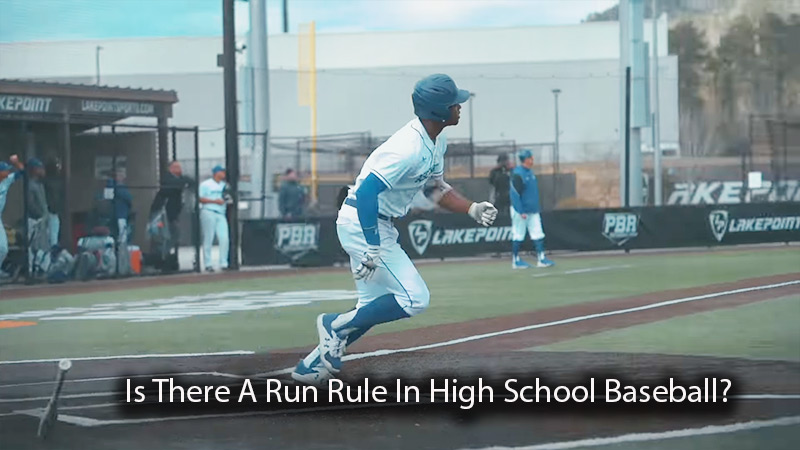
High school athletic events draw passionate crowds, dedicated student-athletes, and intense competition.
However, when a matchup becomes severely lopsided, players, parents, and coaches frequently ask a fundamental question: Is there an official run rule in high school baseball and softball, or does a game only end when one team gives up?
The short answer is yes—official run limits (commonly referred to as “mercy rules”) do exist in high school sports. However, their application is neither uniform nor universally mandatory across every jurisdiction.
Whether a contest is stopped early depends on a complex combination of national guidelines, state association bylaws, tournament structures, and unwritten sportsmanship customs practiced on the field.
This comprehensive analysis breaks down the official governing structures, standard run differentials, regional variations, postseason exceptions, and real-world game management strategies that dictate how lopsided high school games are handled.
The Official Governing Framework: NFHS vs. State Associations
To understand how early-termination rules function, one must first understand how high school athletics are governed in the United States.
       +-------------------------------------------------------+
       |   National Federation of State High School Assns.    |
       |                   (NFHS Framework)                    |
       +-------------------------------------------------------+
                                   |
                                   v
       +-------------------------------------------------------+
       |     Individual State High School Associations         |
       |      (e.g., PIAA, KHSAA, WIAA, Local Districts)        |
       |  -- Decides whether to adopt, modify, or omit rules -- |
       +-------------------------------------------------------+
                                   |
            +----------------------+----------------------+
            |                                             |
            v                                             v
+-----------------------+                     +-----------------------+
| Regular Season Games  |                     |  Postseason Playoffs  |
| (Standard Run Rules)  |                     | (Frequently Suspended) |
+-----------------------+                     +-----------------------+
The Role of the NFHS
The National Federation of State High School Associations (NFHS) establishes the baseline rule framework for high school athletics across the country.
In its default rules, the NFHS includes provisions for a run rule to prevent lopsided contests from becoming unnecessarily drawn out and to protect student-athletes.
State Association Autonomy
Crucially, the NFHS does not impose a mandatory nationwide run rule on every high school program.
Instead, the national body establishes the general rule framework and leaves the explicit adoption and modification of early-termination rules to individual state athletic associations, local leagues, conferences, or tournament organizers. As a result:
- A state association may choose to enforce a standard run rule across all regular-season games.
- A state association may adopt customized sliding scales based on local preferences.
- A state association or league may omit early-termination rules entirely for specific postseason rounds or championship events.
Standard Run Rule Thresholds and Inning Requirements
When a state athletic association or local conference chooses to implement an official run rule, enforcement is based on two primary variables: the run differential and the minimum number of completed innings.
| Run Differential | Minimum Required Innings | Conditions / Notes |
|---|---|---|
| 10 or More Runs | 5 Complete Innings (or 4.5 if Home Team leads) | Default NFHS baseline standard adopted by most state athletic associations. |
| 12 or More Runs | 4 Complete Innings | Adopted by select states and multi-tiered district sliding scales. |
| 15 or More Runs | 3 Complete Innings | Used in severe mismatches to end games quickly and save pitching. |
| 8 or More Runs | 6 Complete Innings | Applied in late-game stages within specific multi-tiered district guidelines. |
The 10-Run Rule Baseline (5 Innings)
The standard baseline recognized across high school athletics is the 10-run rule after 5 complete innings.
- Away Team Leading: If the visiting team establishes a lead of 10 or more runs, the home team must be allowed to complete their turn at bat in the bottom of the 5th inning. If the differential remains 10 or more runs when the 5th inning ends, the game is officially terminated.
- Home Team Leading: If the home team holds a lead of 10 or more runs after the visiting team completes the top of the 5th inning (or hits the 10-run lead threshold during the bottom of the 5th), the game ends immediately without requiring the remainder of the 5th inning to be played.
Accelerated 15-Run Rule (3 or 4 Innings)
To address severe early-game mismatches, many governing bodies supplement the 10-run rule with an accelerated 15-run rule after 3 or 4 innings.
This rule triggers when a team establishes a 15-run cushion early in the contest, eliminating the requirement to play through five full innings.
Regional Variations and Multi-Tiered Sliding Scales
Because state associations maintain total authority over rule implementation, regulations vary significantly depending on geographic jurisdiction.
Washington State
- 15-run margin after 3 innings
- 10-run margin after 5 innings
Kentucky
- 15-run margin after 3 innings
- 10-run margin after 5 innings
Pennsylvania (PIAA / District Level)
- 15-run margin after 3 innings
- 12-run margin after 4 innings
- 10-run margin after 5 innings
- 8-run margin after 6 innings
Single-Threshold vs. Multi-Tiered Systems
- Kentucky Guidelines: Enforce a two-tier system consisting of a 15-run lead after 3 innings and a 10-run lead after 5 innings.
- Washington State Guidelines: Utilizes a matching structure of 15 runs after 3 innings or 10 runs after 5 innings.
- Pennsylvania (PIAA District Scale): Select athletic districts in Pennsylvania enforce a four-tiered sliding scale designed to scale systematically throughout the game: 15 runs after 3 innings, 12 runs after 4 innings, 10 runs after 5 innings, and 8 runs after 6 innings.
These multi-tiered structures provide flexibility for umpires and coaches, ensuring that as a game progresses, the margin required to halt competition shrinks proportionally.
Regular Season vs. Playoff Regulations
One of the most critical distinctions in high school athletics is the operational divide between regular-season play and postseason tournament play.
Regular Season Games
- Goal: Protect player health and manage game schedules.
- Pitching: Help reduce excessive pitching demands.
- Rule Enforcement: Standard or multi-level run rules are generally in effect.
Postseason & Playoffs
- Goal: Provide a complete and fair championship competition.
- Rule Enforcement: Run rules are often suspended, adjusted, or applied differently.
- Focus: Allow postseason games to continue longer to determine a clear winner.
Why Regular Season Games Enforce Run Limits
During the regular season, high school schedules are dense, featuring multiple weekly matchups, tight facility availability, and strict weekly pitch-count limits designed to protect young athletes. Enforcing early-termination rules during regular-season blowouts serves several practical purposes:
- Pitcher Preservation: Prevents teams from burning through pitch counts in non-competitive games.
- Academic and Logistical Management: Ensures student-athletes do not remain at athletic facilities late into the night during school weeks.
- Player Safety: Limits unnecessary exposure to adverse weather conditions or player fatigue.
Why Postseason Games Suspend Run Limits
When teams enter district, regional, or state playoff brackets, many state athletic associations alter or suspend early-termination policies entirely.
In championship play, governing boards prioritize playing complete, full-length contests to ensure the ultimate outcome is decided strictly on the field without abbreviated innings.
Unwritten Rules and On-Field Coaching Tactics
Official regulations are only part of game management. When a contest becomes heavily lopsided before an official run rule can take effect (or in jurisdictions lacking an accelerated 15-run rule), experienced coaches rely on unwritten sportsmanship customs to manage the pace of play.
1. Stepping Off Bases Early
Once a team establishes an insurmountable lead—such as scoring 12 or 13 runs in the top of the 1st inning—coaching staff will frequently instruct baserunners to step off the base before the pitcher releases the ball.
Under standard rules, leaving a base early results in an immediate automatic out, allowing the inning to end quickly without putting additional stress on struggling opposing pitchers.
2. Holding Runners and Preserving Force Plays
Respectful coaches will prohibit baserunners from stealing bases, taking extra bases on wild pitches, or advancing on outfield errors during blowouts.
Furthermore, managers may instruct hitters to stop at first base on clear extra-base hits. Holding runners at first base keeps force plays active across the infield, making it easier for the trailing team’s defense to record the necessary outs.
3. Encouraging Aggressive Hitting
To accelerate the end of an inning, coaches may tell batters to swing at any pitch close to the strike zone. This strategy reduces prolonged walks, puts balls into play quickly for the defense to field, or results in rapid strikeouts.
The Human Impact on Student-Athletes
Unwritten etiquette is particularly important for protecting young pitchers. In extreme blowouts where an inexperienced or struggling pitcher issues numerous consecutive walks, the physical strain and mental frustration can be severe.
Experienced coaches recognize that dragging out an uncontrolled inning hurts athlete morale and damages program relationships.
Real-World Friction, Extreme Weather, and Officiating Challenges
Despite official regulations and unwritten customs, real-world high school athletic events occasionally run into severe friction, rule misunderstandings, or poor sportsmanship.
| Challenge | Example | Potential Issue |
|---|---|---|
| Conflict / Friction | Unnecessary steals, bunt hits, or visible taunting during a large lead | May be viewed as running up the score or creating unnecessary tension |
| Extreme Weather | Continuing to play in freezing temperatures, such as 28°F, during a 31–2 blowout | Raises concerns about player safety and whether continuing the game is appropriate |
| Officiating Errors | Umpires incorrectly applying state run-rule thresholds or making scoring/math mistakes | Can lead to incorrect rule enforcement and disputes during the game |
1. Running Up the Score and Field Friction
Friction occurs when a winning team continues aggressive tactics—such as stealing bases, taking extra bases, or executing squeeze bunts—while holding a massive lead late in a game.
- Etiquette Violations: Continued aggressive play during a blowout is widely regarded as a violation of athletic sportsmanship.
- Bench Tension and Retaliation: When a winning team aggressively runs up the score, it frequently creates hostility between dugouts, leading to verbal confrontations or dangerous on-field retaliation, such as pitchers throwing directly at batters.
2. Extreme Weather Conditions
Official run limits are vital when games take place in adverse weather. For instance, reports from early-season high school games document extreme situations where teams played in 28-degree temperatures with intermittent snowfall while locked in a 31–2 blowout.
When winning coaches refuse to adopt unwritten sportsmanship tactics in freezing weather, student-athletes face genuine safety risks, including muscle strains, numb extremities, and heightened risk of injury.
3. Umpire Misinterpretations and Math Errors
Enforcing run rules requires umpires to have an accurate understanding of local state athletic association bylaws.
Real-world instances reveal that umpires occasionally misinterpret local rules—such as calling a game early under an incorrect run differential (e.g., stopping a 21–11 game after 3 innings under the mistaken belief that a 10-run lead triggers a 3rd-inning mercy rule).
Clear communication between head coaches and the officiating crew during pre-game home-plate conferences is essential to prevent these errors.
Conclusion
While high school mercy rules operate under general NFHS guidelines, official adoption rests entirely with individual state athletic associations and local leagues.
Whether enforced through the standard ten-run rule after five innings, an accelerated fifteen-run limit after three innings, or modified during postseason play, these official regulations prevent unnecessarily drawn-out games.
When combined with unwritten sportsmanship customs—such as stepping off bases early or holding runners—understanding both formal athletic bylaws and on-field sportsmanship etiquette ensures coaches, umpires, and parents handle lopsided competition smoothly, efficiently, and respectfully.